

Make a donation
Mexico City topographic map
Click on the map to display elevation.
Make a donation
Mexico City
Mexico is crossed from north to south by two mountain ranges known as Sierra Madre Oriental and Sierra Madre Occidental, which are the extension of the Rocky Mountains from northern North America. From east to west at the center, the country is crossed by the Trans-Mexican Volcanic Belt also known as the Sierra Nevada. A fourth mountain range, the Sierra Madre del Sur, runs from Michoacán to Oaxaca. The majority of the Mexican central and northern territories are located at high altitudes, and as such the highest elevations are found at the Trans-Mexican Volcanic Belt: Pico de Orizaba (5,700 m or 18,701 ft), Popocatépetl (5,462 m or 17,920 ft) and Iztaccihuatl (5,286 m or 17,343 ft) and the Nevado de Toluca (4,577 m or 15,016 ft). An important geologic feature of the Yucatán peninsula is the Chicxulub crater. The scientific consensus is that the Chicxulub impactor was responsible for the Cretaceous–Paleogene extinction event. Mexico is subject to several natural hazards, including hurricanes on both coasts, tsunamis on the Pacific coast, and volcanism.
Make a donation
About this map

Name: Mexico City topographic map, elevation, terrain.
Location: Mexico City, Cuauhtémoc, Mexico City, Mexico (19.24195 -99.30495 19.57969 -98.97505)
Average elevation: 2,344 m
Minimum elevation: 2,223 m
Maximum elevation: 3,719 m
Make a donation
Other topographic maps
Click on a map to view its topography, its elevation and its terrain.
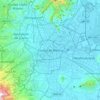
Mexico City
Mexico > Mexico City > Mexico City
Mexico City is located in the Valley of Mexico, sometimes called the Basin of Mexico. This valley is located in the Trans-Mexican Volcanic Belt in the high plateaus of south-central Mexico. It has a minimum altitude of 2,200 meters (7,200 feet) above sea level and is surrounded by mountains and volcanoes that…
Average elevation: 2,321 m


Make a donation



Make a donation
