

Make a donation
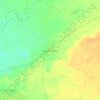
Ravi River topographic map
Click on the map to display elevation.
Make a donation
Ravi River
The Ravi River originates in the Himalayas in the Multhan tehsil of Kangra district of Himachal Pradesh, India. It follows a north-westerly course and is a perennial river. It is the smallest of the five Punjab rivers that rise from glacier fields at an elevation of 14,000 feet (4,300 m), on the southern side of the Mid Himalayas. It flows through Barabhangal, Bara Bansu, and Chamba districts. It flows in rapids in its initial reaches with boulders seen scattered in the bed of the river. The Ravi River in this reach flows in a gorge with a river bed slope of 183 feet per mile (34.7 m/km) and is mostly fed by snowmelt, as this region lies in a rain shadow. Two of its major tributaries, the Budhil and Nai or Dhona join 64 kilometres (40 mi) downstream from its source. The Budhil River rises in Lahul range of hills and is sourced from the Manimahesh Kailash Peak and the Manimahesh Lake, at an elevation of 4,080 metres (13,390 ft), and both are Hindu pilgrimage sites. The entire length of Budhil is 72 kilometres (45 mi) where it has a bed slope of 314 feet per mile (59.5 m/km). It flows through the ancient capital of Bharmwar, now known as Bharmour in Himachal Pradesh. During 1858–1860, the Raja of Bharmour had considered the Budhil valley as an excellent source of Deodar trees for supply to the British Raj. However, a part of the forest surrounding the temple was considered sacred and declared a reserved area. The second tributary, the Nai, rises at Kali Debi pass, and flows for 48 kilometres (30 mi), with a bed slope of 366 feet per mile (69.3 m/km), from its source at Trilokinath to its confluence with the Ravi. This valley was also exploited for its forest wealth during the English period.
Make a donation
About this map

Name: Ravi River topographic map, elevation, terrain.
Average elevation: 171 m
Minimum elevation: 165 m
Maximum elevation: 178 m
Make a donation
Other topographic maps
Click on a map to view its topography, its elevation and its terrain.


Rawalpindi
Pakistan > Punjab > Rawalpindi District > Rawalpindi Cantonment
Rawalpindi features a humid subtropical climate (Köppen: Cwa) with hot and wet summers, a cooler and drier winter. Rawalpindi and its twin city Islamabad, during the year experiences an average of 91 thunderstorms, which is the highest frequency of any plain elevation city in the country. Strong windstorms…
Average elevation: 530 m
Make a donation


Make a donation


Make a donation

Faisalabad
The soil consists of young stratified silt loam or very fine sand loam which makes the subsoil weak in structure with common kankers at only five feet. The course of the rivers within Faisalabad are winding and often subject to frequent alternations. In the rainy season, the currents are very strong. This…
Average elevation: 184 m

Murree
Pakistan > Punjab > Murree District
Murree (Punjabi, Urdu: مری) is a mountain resort city, located in the Galyat region of the Pir Panjal Range, within the Muree District of Punjab, Pakistan. It forms the outskirts of the Islamabad-Rawalpindi metropolitan area, and is about 30 km (19 mi) northeast of Islamabad. It has average altitude of…
Average elevation: 1,718 m
Make a donation

Bahawalnagar
In 1904 when Nawab Mohammad Bahawal Khan Abbasi IV, who originally ruled over Bahawalpur State visited Rojhanwali the people asked that with His permission they want to rename the city on the name of Nawab, The Nawab allowed them with pleasure and since then the city is named as Bahawalnagar. With the advent…
Average elevation: 158 m


Make a donation


Make a donation
Gujranwala
Gujranwala sits at the heart of the Rechna Doab, a strip of land between the Chenab in the north, and Ravi River in the south. Gujranwala is also part of the Majha, a historical region of northern Punjab. The city was built upon the plains of Punjab, and the surrounding region is an unbroken plain devoid of…
Average elevation: 225 m


Make a donation


Make a donation


Make a donation


Make a donation




Make a donation


Make a donation


Make a donation


Make a donation


Make a donation




Make a donation



Make a donation

Make a donation


Make a donation


Panjpeer Rocks
Pakistan > Punjab > Rawalpindi District > Kotli Sattian Tehsil
Average elevation: 1,466 m

Make a donation

Make a donation



Make a donation


Make a donation



Make a donation


Make a donation