Make a donation
Whitehorse topographic map
Click on the map to display elevation.
Make a donation
Whitehorse
Whitehorse has a subarctic climate (Köppen climate classification: Dfc) and lies in the rain shadow of the Coast Mountains, causing precipitation totals to be quite low year-round. Due to the city's location in the Whitehorse valley, the climate is milder than other comparable northern communities such as Yellowknife, however during cold snaps it is not uncommon for temperatures to drop below −40 °C (−40 °F). With an average annual temperature of −0.1 °C (31.8 °F) Whitehorse is the warmest place in the Yukon. The temperature measurements for the city are taken at the airport. The Whitehorse Riverdale weather station situated at a lower elevation than the airport is even warmer at 0.2 °C (32.4 °F).
Make a donation
About this map

Name: Whitehorse topographic map, elevation, terrain.
Location: Whitehorse, Yukon, Canada (60.56157 -135.21493 60.88157 -134.89493)
Average elevation: 1,008 m
Minimum elevation: 629 m
Maximum elevation: 1,894 m
Make a donation
Other topographic maps
Click on a map to view its topography, its elevation and its terrain.


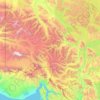
Kluane National Park and Reserve
The Reserve includes the highest mountain in Canada, Mount Logan (5,959 metres or 19,551 feet) of the Saint Elias Mountains. Mountains and glaciers dominate the park's landscape, covering 83% of its area. The rest of the land in the park is forest and tundra—east of the largest mountains and glaciers—where…
Average elevation: 1,536 m
Make a donation